


Remembering and Honoring Edith Eva Eger
- Best Ever You

- Apr 30
- 4 min read
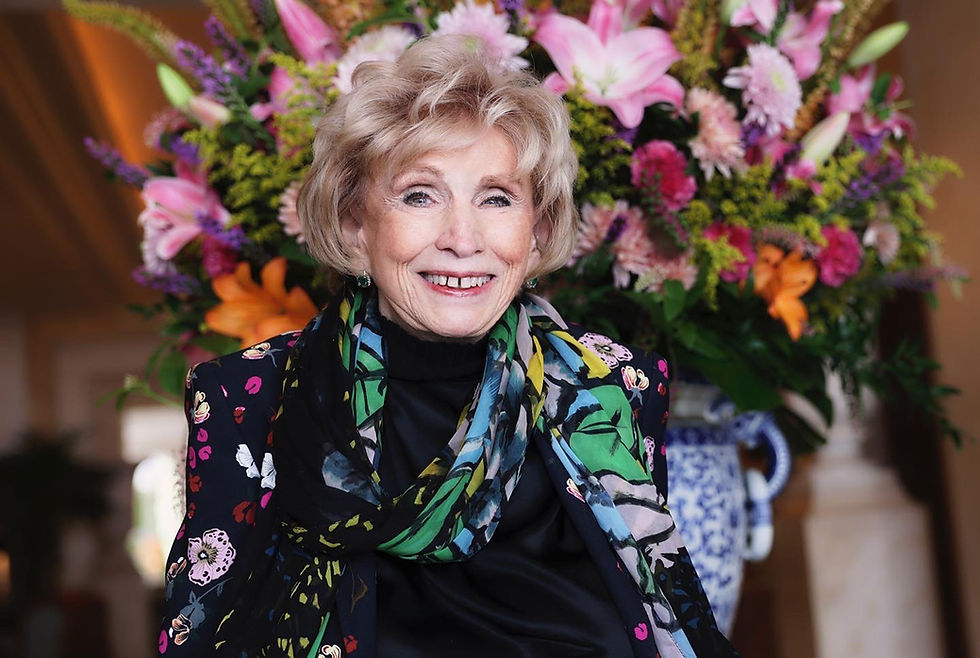
Beloved Dr. Edith "Edie" Eger passed away on Monday, April 27, at the age of 98. Edie's light, her wisdom, and her unshakable belief in the power of choice touched countless lives, and the world feels quieter without her in it.
“If I survive today,” Edith Eva Eger would tell herself each day of her imprisonment at
Auschwitz, “tomorrow I will be free.”
Edith was just sixteen years old, training as a dancer and Olympic gymnast in Hungary, when Nazis raided her home at dawn and packed her and her family into a cattle car bound for Auschwitz. Edith’s parents, Ilona and Lajos Elefànt, were killed in the gas chambers as soon as they arrived.
That night, Josef Mengele, the infamous “Angel of Death,” came to the barracks in search of entertainment. When he learned that Edith was a skilled gymnast and dancer, he ordered her to perform for him. She survived the ordeal by imagining she was on stage at the Budapest Opera House, dancing to Tchaikovsky’s Romeo and Juliet.
This became one of Edie’s most important survival strategies. As her mother had instructed her in the cattle car bound for Auschwitz, “No one can take away what you’ve put in your own mind.”
Edie and her eldest sister, Magda, survived multiple death camps and the Death March, arriving at Gunskirchen Lager in the spring of 1945. When American troops from the 71st Infantry Division liberated the camp on May 4, 1945, Edie was nearly left for dead, but an African-American GI (from the all-black 761st Tank Battalion) discovered her barely alive in a pile of corpses.
On their way home to Hungary after the war, Edie and Magda learned that their middle sister, Klara, a violin prodigy, had miraculously survived the war. The three sisters reunited in Kosice and attempted to restart their lives.
In November 1946, at age 19, Edie married Béla Eger, a partisan fighter from a prominent Slovakian family she had met while recuperating at a TB hospital in the Tatra Mountains. Edie’s sisters also married and then emigrated, Magda to Baltimore, and Klara to Sydney, Australia. Edie and Béla, fleeing persecution by the Communists, chose a different path, packing all of their possessions into a boxcar that would carry their fortune to Italy, and then on to Haifa, Israel, by ship. But at the last moment, Edie refused the long-awaited opportunity for her family to move to Israel, and resolved to come to America instead; she and Béla and their young daughter, Marianne, arrived at Ellis Island in October 1949, penniless, having forfeited everything they owned.
The family settled in Baltimore in a small, rented room. Béla took a job as a manual laborer and Edie at a factory, cutting the loose threads off the seams of boxer shorts, paid 7 cents per dozen. Though Edie began to suffer debilitating flashbacks, she did not tell anyone in her new life that she was a Holocaust survivor. In 1955, the family, including a second daughter, Audrey, aged one, left Baltimore for El Paso, Texas, where Béla advanced a new career as a CPA, they welcomed a third child–a son, John–and bought their first house. Still, Edie was silent about the past. “I had my secret,” she would later say, “and my secret had me.”
Then, 21 years after her liberation, while pursuing a degree at the University of Texas, Edie received a book from a classmate that irrevocably transformed her life. At first, she resisted reading Auschwitz survivor and psychiatrist Viktor Frankl’s Man’s Search for Meaning, but when she mustered the courage to begin, she realized that speaking about the past might help free her. She would later write, Each moment is a choice. No matter how frustrating or boring or constraining or painful or oppressive our experience, we can always choose how we respond. In 1968, a letter from Viktor Frankl–From one survivor to another, the salutation read– began a years-long correspondence and friendship that explored deep questions about trauma and healing and spurred Edie, in the mid-1970s, to begin graduate work in psychology. Later, working as a clinical intern at the William Beaumont Army Medical Center at Fort Bliss, Texas, Dr. Eger earned a reputation for being able to treat even the most troubled and recalcitrant combat veterans in her care.
While her own traumatic experiences lent her credibility with patients living with their own horrific memories and losses, Eger felt limited in her capacity to help others heal. She could only take her patients as far as she could go herself. And she was still at a stalemate with her past.
So began Eger’s work to come to terms with the unanticipated and unimaginable–a journey that would take her from the floor of her therapist’s office where she curled up in fetal position, releasing decades of bottled up rage and grief, to the gates of Auschwitz where she returned in 1980 and was finally able to forgive the one person she had been unable to forgive for years. Not Hitler. Not Josef Mengele. Herself.
One of the last remaining Holocaust survivors old enough to remember life in the death camps, Eger became a globally renowned speaker, a pioneer in psychology, a consultant for the U.S. Army and Navy in resiliency training and the treatment of PTSD, and a bestselling and award-winning author of three books: The Choice: Embrace the Possible (Scribner), a New York Times bestseller, translated into 44 languages; The Gift: 14 Lessons to Save Your Life (Scribner); and The Ballerina of Auschwitz (Atheneum).
Calling Auschwitz her “best classroom,” Dr. Eger used the inner resources she developed in hell to help others–from combat veterans and Navy SEALs to survivors of sexual and domestic violence–to transcend the prisons of their own minds and choose freedom. She continued to treat patients and inspire audiences–and dance–well into her 90s and teaches us that we can find purpose in our suffering, choose to love and forgive others and ourselves, and cultivate hope and joy in our lives.
Dr. Eger’s message and legacy carry on through The Edith Eger Foundation.
I can’t heal you–or anyone–but I can celebrate your choice to dismantle the prison in your mind, brick by brick. You can’t change what happened, you can’t change what you did or what was done to you. But you can choose how you live now.
My precious, you can choose to be free.
- Edith Eger, The Choice
As Dr. Edith Eger taught us, even in the hardest moments, we still have a choice in how we respond.


Comments